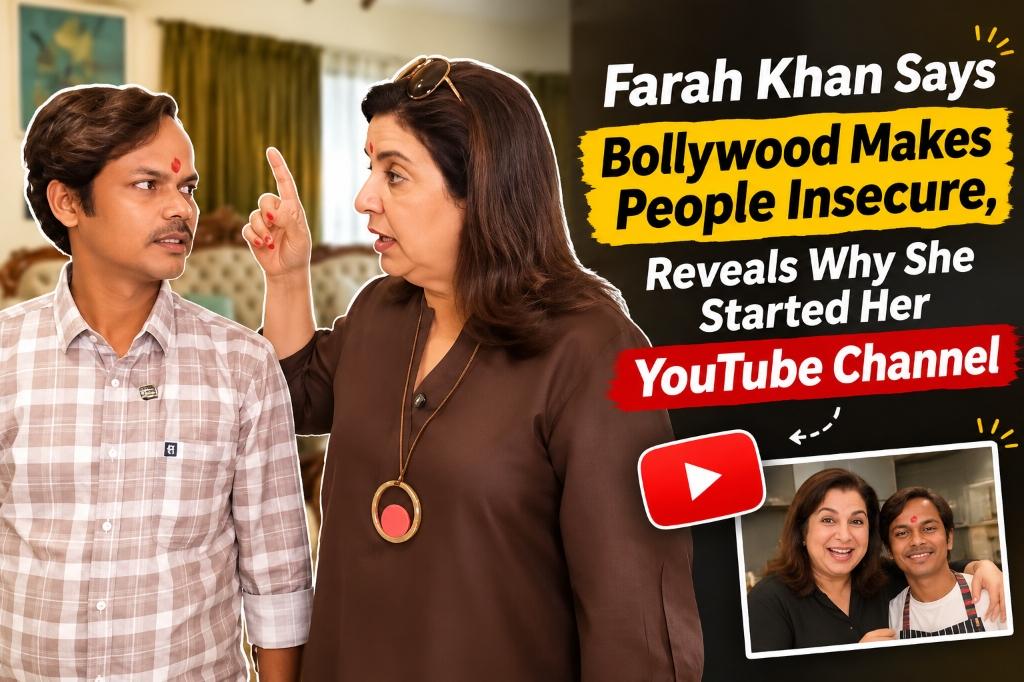
Farah Khan has commanded sets as one of Indian cinema’s most iconic choreographers, directed blockbusters that defined pop culture, and judged reality television for decades. Now, she is also one of the digital world’s most sought-after creators. But did she map this runaway internet triumph from day one? According to Farah, not in the slightest.
In an unfiltered chat on Neha Dhupia and Angad Bedi’s podcast, Farah reflected candidly on the roots of her digital venture, her deep-seated fear of sitting idle between projects, and the psychological weight of competition in Bollywood that can leave even veteran creators feeling diminished.
Farah Khan Did Not Plan Her YouTube Journey
Congratulating Farah on crossing the remarkable milestone of 300 vlog episodes, Neha asked whether the transition from silver screen titan to digital sensation was a calculated corporate roadmap. Farah firmly dismissed the idea.
She revealed that she had just wrapped up the screenplay for her next directorial feature and suddenly found herself staring at an open schedule. Rather than succumb to the paralyzing anxiety of waiting for green lights, she picked up a camera so she wouldn't feel restless during the interim. While industry observers praise her for executing a textbook career pivot, Farah attributes it entirely to destiny.
“Later everyone said that I pivoted at the right time, but that is all destiny. I get angsty, and if one is not doing anything, then after waking up they think that my film is not happening and someone else is making theirs. I can’t go through that. I have been through it when I wanted to make my first movie.”
“This Industry Makes You Insecure”
Speaking with raw honesty, Farah delved into the incessant pressure cooker environment of Bollywood, recalling how the dread of being sidelined plagued her early career before she finally broke through with Main Hoon Na in 2004.
That perpetual loop of professional comparison prompted a conscious psychological reset once she reached her fiftieth milestone:
“This industry makes you insecure. Because at all times you are comparing yourself to somebody else. That this actor is doing this film and what not. When I hit 50, I told myself that I want to detach, cut off and live a happy life. But of course, we are hustlers, and YouTube is something that I didn’t realise that there was a lack of family-oriented content perhaps and people liked it, and of course they liked Dilip. As we went along, we kept tweaking the format.”
Turning 50 served as an emotional turning point: she actively chose contentment over relentless rat-race validation. YouTube offered creative autonomy, low friction, and an authentic playground that unexpectedly transformed into a multimedia juggernaut.
What Is Farah Khan’s YouTube Channel About?
Launched in April 2024, Farah’s channel pioneered an intimate, unscripted lifestyle format. In each episode, she visits celebrity friends at their homes, takes viewers on candid house tours, heads straight into their personal kitchens to whip up a dish, and sits down for honest conversations over good food.
Yet by her own admission, the true anchor of the channel is her cook, Dilip. Their spontaneous bickering, comedic banter, and unpretentious rapport quickly became the secret sauce that set the vlogs apart from polished PR interviews. As reported by Hindustan Times, the channel has now amassed over 3 million dedicated subscribers.
Dilip’s own meteoric rise has been nothing short of a modern fairy tale. Today, he is a recognizable pop culture personality in his own right, even featuring alongside Shah Rukh Khan in high-profile brand advertisements like Myntra. Farah revealed in earlier vlogs that she channeled a significant portion of her initial YouTube earnings to clear Dilip’s long-standing debts and gave him substantial salary bumps as the venture expanded.
Farah Khan’s Blockbuster Film Legacy
- Main Hoon Na (2004): Directorial debut starring Shah Rukh Khan and Sushmita Sen; emerged as one of the year’s highest grossers.
- Om Shanti Om (2007): Launched Deepika Padukone opposite SRK; became a worldwide historic blockbuster.
- Tees Maar Khan (2010): Starred Akshay Kumar and Katrina Kaif, giving Hindi cinema the iconic anthem Sheila Ki Jawani.
- Happy New Year (2014): Ensemble heist comedy that broke opening day box office records across India.
In a previous conversation, Farah acknowledged a reality that surprised industry watchers: her annual digital income from YouTube now outpaces what she took home from big-screen filmmaking in any single year. It underscores how creator-led digital media has fundamentally decentralized star power in India.
Why This Matters
Farah Khan’s reflection resonates because it demystifies the glitz of Bollywood. If a director with four tentpole releases and decades of industry cachet still wrestles with comparison and career angst, it proves that insecurity in show business is universal.
More importantly, her journey demonstrates that detaching from the treadmill of prestige filmmaking can open up avenues far more lucrative and liberating. Sometimes, the most culturally engaging storytelling doesn’t demand a ₹200 crore studio budget—it simply needs a warm kitchen, an old friend, and a cook whom millions adore.
Stay tuned to Buzz OG for daily unfiltered scoops, celebrity interviews, and Bollywood insights.