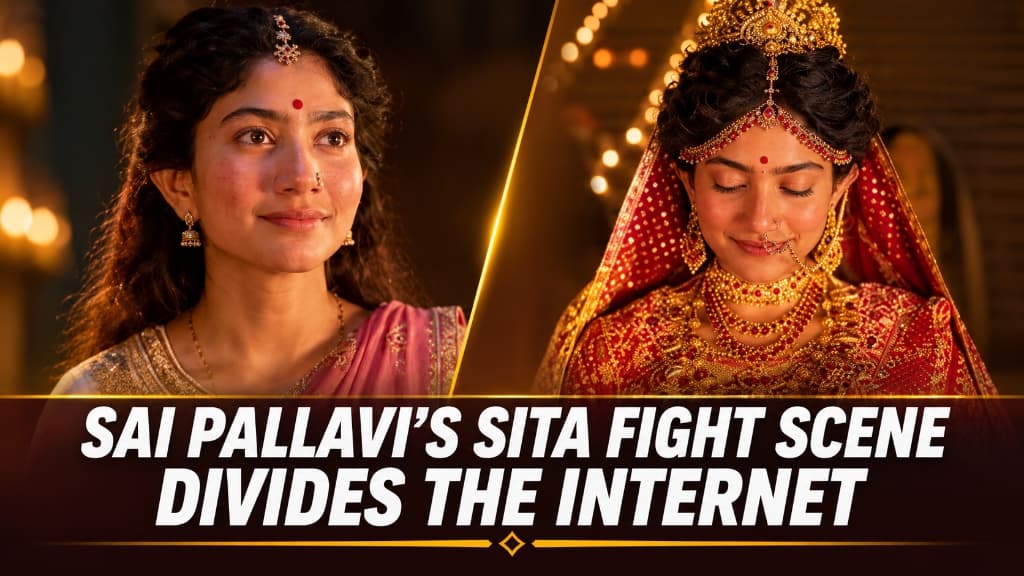
Nitesh Tiwari’s magnum opus Ramayana: Rise of a Legend is officially in theatres across the globe. But within hours of its theatrical release, one particular creative sequence has ignited a fiery debate across social media feeds.
In the scene, Sai Pallavi’s Sita is seen actively fighting demons in the Dandakaranya forest. While a segment of viewers has celebrated her fierce, warrior-like agency, traditionalists argue that putting weapons in Sita’s hands departs significantly from the sacred text they grew up reading.
Here is the full story, the scriptural roots, and the filmmaker’s explanation in simple words.
What Is the Fight Scene About?
The sequence unfolds during the pivotal Dandakaranya forest episode, where Lord Ram confronts the demon generals Khara and Dushana and their menacing battalion. On screen, Sita is shown physically defending herself and taking down attacking demons alongside Ram.
Many viewers immediately noted that this does not align with the standard cinematic or literary tellings of the epic. The discussion comes at a time when the film is already receiving divided critical reactions, and Sai Pallavi has faced scrutiny from orthodox circles ever since her casting was announced.
Notably, this creative choice was not a complete surprise. An official behind-the-scenes video released by the production house on October 17 had previously teased Sita wielding weapons in a combat-ready avatar.
What Did the Internet Say?
The viral storm began gaining traction following a widely-shared post on X (formerly Twitter) on November 3. The post pointed out that in the classical epic, Lord Ram deliberately insulated Sita and Lakshman from the clash:
“Ram fought 14,000 demons alone and sent Lakshman and Sita away to safety. Another fraud from #Ramayana, or should I say Scamyana.”
Other netizens echoed similar objections, claiming that Lord Ram fought the entire demonic army alone and that Sita would never have been permitted onto the chaotic frontline. One user quipped with humour: “First in my bloodline to know that Sita mata fought with demons.”
Fans Who Back Sita’s Warrior Look
However, a large faction of moviegoers has come out strongly in defence of the film’s vision. They argued that depicting Sita purely as a passive, helpless damsel does a disservice to her divine divinity.
Supporters highlighted alternate canonical texts—specifically the Adbhuta Ramayana—where Sita is explicitly celebrated as a powerful warrior manifestation of Goddess Shakti who slays cosmic demons when even the gods falter.
What Do the Scriptures Say?
To understand the debate fairly, one has to examine how different versions of the Ramayana treat Sita:
- Valmiki Ramayana: In Maharishi Valmiki’s original Sanskrit text, there is no mention of Sita participating in physical combat during the 14-year forest exile. Lakshman disfigured Surpanakha, both brothers fought the demon Viradha together, and Lord Ram single-handedly destroyed Khara, Dushana, and their 14,000 warriors.
- The Khara-Dushana Battle in Aranyakanda: Valmiki explicitly writes that before engaging Khara’s massive army, Lord Ram instructed Lakshman to escort Sita to a concealed, secure mountain cave for her protection. This directly validates the purists' critique.
- Adbhuta Ramayana: Attributed to sage Valmiki as well, this Shakta-oriented text presents Sita as the supreme Mahakali. When Lord Ram collapses while facing Sahasramukha Ravana (the thousand-headed demon king), Sita assumes her terrifying cosmic warrior form to annihilate the demon army and save the universe. Thus, Sita as a battle-ready deity is deeply rooted in Hindu lore, though the specific forest skirmish in Tiwari's film adapts this spirit into a new setting.
What Did Nitesh Tiwari Say?
Director Nitesh Tiwari had preemptively addressed this creative decision during the film's Los Angeles press premiere prior to the controversy breaking out.
Tiwari explained that cinematic adaptations require balancing reverence with narrative dynamism:
“She does have action in hers too… Lord Ram stays the same in every version. But some characters allow creative liberties, and drawing Sita’s warrior princess dimension from the Adbhuta Ramayana kind of adds a nice dimension to her as a character.”
Tiwari underscored that exploring Sita’s inner resilience and physical strength honors her divine lineage as Janaka’s brave daughter rather than diminishing it.
About the Film: Fast Facts
- Title: Ramayana: Rise of a Legend (Part 1)
- Director: Nitesh Tiwari
- Starring: Ranbir Kapoor (Lord Ram), Sai Pallavi (Sita), Yash (Ravana), Sunny Deol (Hanuman), Ravi Dubey (Lakshman), Lara Dutta (Kaikeyi), Rakul Preet Singh (Surpanakha)
- Music & Score: Hans Zimmer and A.R. Rahman
- Budget: Estimated around ₹4,000 crore across both parts
- Theatrical Rollout: November 5, 2026 worldwide; Part 2 is slated for 2028
Our Take
The debate ultimately boils down to a timeless dilemma in mythological cinema: should a film strictly mirror Valmiki’s literal verses, or can it weave in traditions from the 300+ diverse Ramayana versions that have enriched Indian culture for centuries?
While the forest battle scene takes obvious cinematic liberties with Valmiki’s Aranyakanda, the filmmakers have grounded their creative choice in the philosophical traditions of the Adbhuta Ramayana. Now that the film is running on thousands of screens, the ticket-buying public will deliver the ultimate verdict.
Stay tuned to Buzz OG for continuous box office numbers, audience reactions, and in-depth Bollywood analysis.
- → Karan Johar Calls Ramayana Part 1 a “Miracle” and Praises Ranbir Kapoor’s Lord Ram
- → Ramayana Part 2 Postponed to 2028: Namit Malhotra Confirms, Hints at a Trilogy
- → Ramayana Advance Booking: US Sales Jump 27% After LA Premiere
- → Inside Ramayana’s LA Premiere: Ranbir Kapoor, Yash & Sai Pallavi Steal the Red Carpet