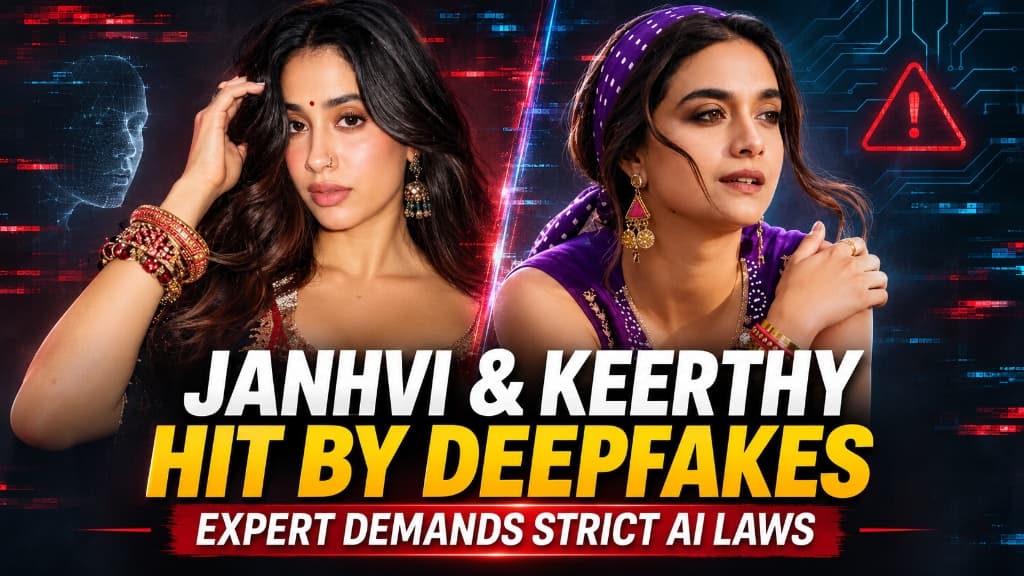
Artificial intelligence misuse in the Indian entertainment industry has escalated dramatically, with leading stars Janhvi Kapoor and National Award-winner Keerthy Suresh emerging as the latest targets of sexually explicit and non-consensual AI-manipulated media. In the wake of intense outrage, leading industry professionals are now urging the central government to enforce strict, mandatory statutory labelling laws on synthetic content.
The rapid proliferation of sophisticated deepfake generators has highlighted severe vulnerabilities in digital consent, sparking fierce debates across Bollywood and regional film industries on how to protect privacy and personality rights in the age of generative tech.
What Happened to Janhvi Kapoor?
A fabricated, sexually explicit video featuring Janhvi Kapoor surfaced across social media platforms and encrypted messaging groups in early October 2026. The creators extracted visual sequences from Chuttamalle, her chartbuster song alongside Jr NTR from Koratala Siva’s blockbuster Devara: Part 1 (2024), and digitally superimposed her face and likeness into explicit adult content.
Co-star Jr NTR was among the first prominent figures to react, condemning the malicious clip and calling for prompt criminal prosecution while urging netizens to refrain from viewing, forwarding, or hosting the synthetic footage. Veteran actor and politician Khushbu Sundar likewise censured the malicious act, calling it a gross violation of female dignity.
“The weaponisation of this technology is deeply violating, bordering on sexual assault. Almost every woman in my industry has faced some version of this, and the normalization of digital harassment cannot be tolerated.”
— Janhvi Kapoor on Instagram
Also Read on Buzz Originals
Related Janhvi Kapoor coverage: Janhvi Kapoor Breaks Silence on Peddi Controversy: “A Violating Experience” and Cyber Crime Complaint Filed in Hyderabad Over Leaked Celebrity Materials.
What About Keerthy Suresh & Widespread Industry Targets?
Acclaimed actress Keerthy Suresh voiced profound shock after discovering synthetic, AI-manipulated photographs of herself circulating on Reddit and X (formerly Twitter). She highlighted the sinister threat posed by freely accessible generative AI suites, noting that actresses are repeatedly targeted without consent.
She joins a growing roster of female artists who have taken a stand:
- Sunainaa: Warned malicious handles of severe legal repercussions after synthetic clips surfaced online.
- Rashmika Mandanna: Whose viral November 2023 elevator deepfake triggered national outcry and initial IT rule advisories.
- Katrina Kaif, Alia Bhatt & Samantha Ruth Prabhu: Who have all been targeted by hyper-realistic cloned imagery and voice-cloning software in recent months.
What Does the VFX & Tech Expert Say?
Prominent VFX veteran CB Arun Kumar, Dean of Communications, Film and Gaming at Pearl Academy, broke down the technical, cultural, and legal remedies urgently required:
| Key Recommendation | Expert Rationale |
|---|---|
| Compulsory AI Watermarking | Enact statutory legislation mandating bold, indelible, visual and cryptographic metadata labels identifying synthetic media. |
| Platform Algorithmic Responsibility | Social networks must deploy AI classifiers at ingest to flag and label manipulated videos before algorithmic amplification. |
| Speed vs Historical Tooling | Image manipulation existed during the Photoshop era, but generative diffusion models allow instant creation and frictionless virality. |
| Artist Empowerment | Digital creators and animators should master AI tooling responsibly rather than fear it, establishing ethical industry benchmarks. |
What Is the Legal Situation in India?
While India’s Ministry of Electronics and Information Technology (MeitY) has issued recurring advisories under the IT Act, 2000, and the IT Rules, 2021, regulatory enforcement continues to evolve:
- Personality Rights Protection: In August 2026, the Delhi High Court passed an omnibus interim order protecting the personality, image, and publicity rights of Janhvi Kapoor and her sister Khushi Kapoor, restraining unauthorized commercial or derogatory use of their likeness.
- Digital Takedowns: While links on major cloud platforms including Google Drive were swiftly taken down following infringement notices, investigative reports note that persistent mirrors remain on unregulated offshore adult domains.
- Proposed IT Legislation: Reuters reports that the central government is currently finalizing stringent IT rule amendments that will penalize intermediaries and generative AI platforms that fail to watermark or identify synthetic content.
Why This Matters: Preserving Digital Dignity
Deepfakes are not victimless technological novelties. In a matter of minutes, an AI-generated clip can inflict severe reputational damage, psychological trauma, and personal distress. Because synthetic media persists across fragmented server mirrors, preventative labelling and aggressive criminal liability are essential to safeguarding women across society.
How You Can Help Prevent Deepfake Spread
Cyber experts urge citizens and internet users to maintain vigilant digital hygiene:
- Do Not Share: Never forward, retweet, or amplify suspicious media, even out of curiosity or as satire.
- Spot the Artifacts: Look for visual giveaways such as mismatched audio-lip synchronisation, flickering hairline borders, abnormal blink frequencies, and inconsistent lighting shadows.
- Report Immediately: Utilize in-app reporting tools on platforms to flag synthetic non-consensual media.
- Cybercrime Grievance: If you or anyone you know is targeted, lodge a formal report at cybercrime.gov.in or call the National Cyber Crime Helpline at 1930.